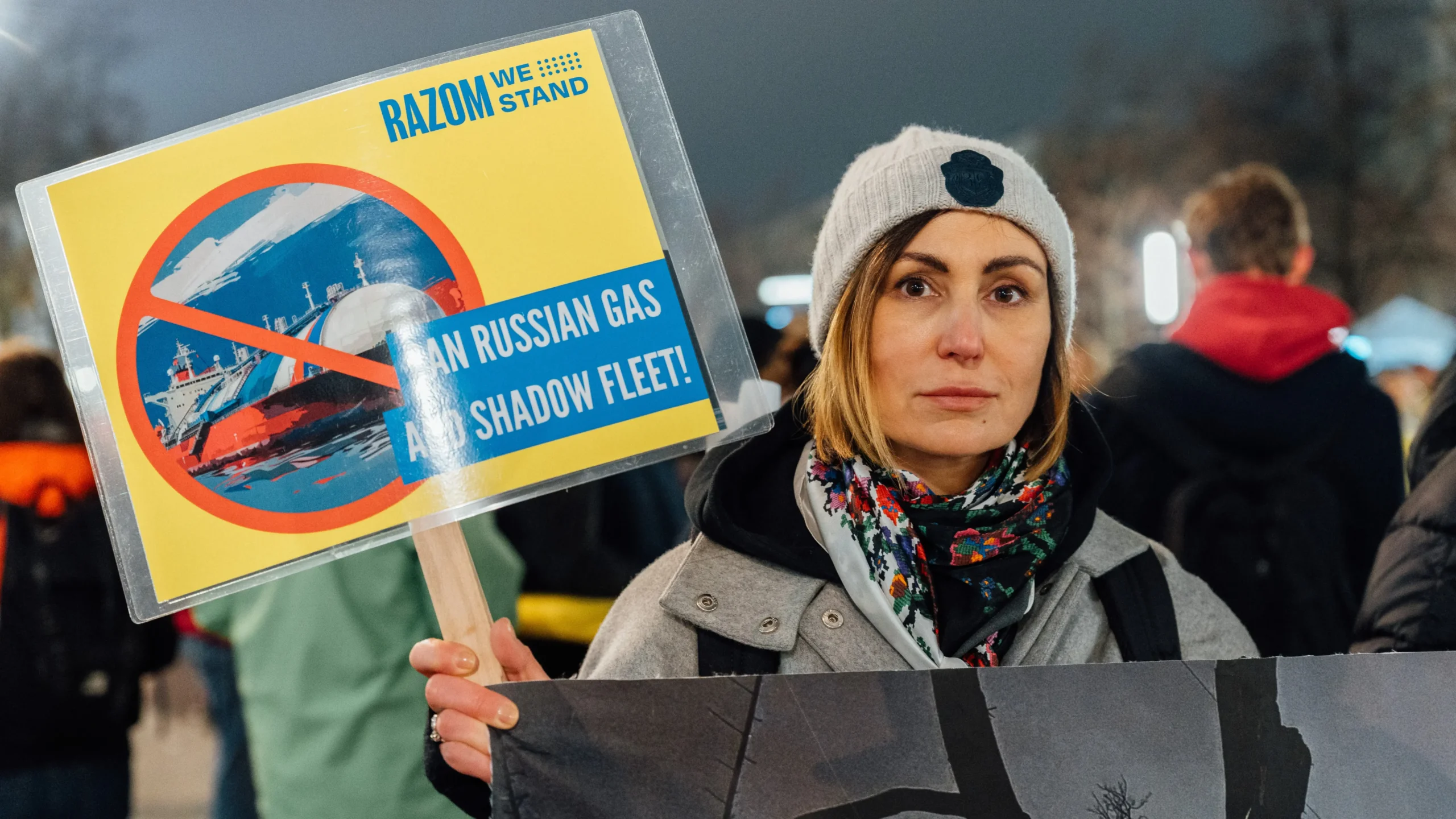
A new report, Europe’s Russian Energy Dependency Scorecard, assessing Belgium, France, Germany, Spain, and the United Kingdom, details the evidence of continued EU support for Russia’s war chest. The findings are stark: every country has failed to act beyond what EU legal minimums; corporate interests have repeatedly trumped political commitments, and the companies enabling Russia’s flagship Yamal LNG project are still operating in plain sight.
Europe’s dependence on Russian gas was never merely an environmental or financial problem — it was always a security threat. Russia has used energy as a weapon against Ukraine for decades, cutting supplies, manipulating prices, and treating gas contracts as geopolitical leverage. The full-scale invasion of Ukraine in 2022 made this undeniable.
Over the last four years, the EU has spent over €200 billion on Russian oil and gas imports. Germany, Belgium, France and Spain alone paid more than €65 billion to Russia since 2022 — countries that publicly declare political will to end all Russian energy imports. Yet in 2025, European companies were still sending over €7 billion to Russia’s Yamal LNG project alone.
Every tanker that docks at Zeebrugge, Bilbao, Dunkirk, or Montoir to unload Russian gas is helping fund the Russian army at the expense of the European buyers. The UK adds to this: British ship managers and insurers still facilitate the vast majority of Russia’s LNG export shipments — even as the UK has maintained a complete ban on Russian LNG imports since January 2023.
Corporate complicity is the weakest link across all five countries.
TotalEnergies (France) holds a 20% equity stake in Yamal LNG and purchases 5 million tonnes of Russian LNG per year under contracts running to 2041. The company has stated publicly that it will continue to be a shareholder in Yamal, even as it moves away from Russian LNG, under EU regulations. In 2025, French terminals handled 6.3 million tonnes of Yamal LNG — 42% of all EU imports from the project — worth over €3.16 billion to Russia.
Securing Energy For Europe (SEFE) (Germany) — 100% owned by the German state — continued buying 2.9 million tonnes of Russian LNG per year through French and Belgian terminals long after Berlin declared it had ended its Russian gas dependency. The German Economy Ministry only began pressing SEFE to invoke force majeure and exit the contract in November 2025 — nearly four years after Russia’s full-scale invasion. A state-owned company, using taxpayer-backed infrastructure, sustained the Kremlin’s revenue stream while the German government claimed it had moved on.
Fluxys (Belgium) operates Zeebrugge, the EU’s single-largest Russian LNG terminal, under long-term contracts with Yamal LNG that run into the 2030s. Belgium’s LNG imports from Russia were higher in 2023–2025 than before the invasion. When the EU’s transhipment ban prevented cargoes from being re-exported to Asia, they stayed in Europe instead — and Zeebrugge’s intake rose, not fell. Zeebrugge is the top Yamal hub with 4.2 million tonnes received in 2025, more than any single Chinese port.
Naturgy (Spain) holds a 2.5 million-tonne-per-year Yamal LNG contract running until 2038. Even after Spain cut total Russian LNG imports in 2025, Naturgy’s contract kept Russia as Spain’s third-largest LNG supplier. The company’s CEO has warned Brussels of “hefty penalties” if forced to exit early — and Madrid’s backroom lobbying against a tougher gas ban in 2025 is widely understood as an attempt to protect Naturgy’s balance sheet.
Seapeak Maritime Glasgow Ltd. (UK) — a UK-registered ship management company — transported 37% of all Yamal LNG exports in 2025, three years after the UK banned Russian LNG imports. British ships, British insurers and British-registered ship managers (Seapeak Maritime Glasgow Ltd, NYK Energy Transport Atlantic, MOL LNG Transport Europe Ltd.) are all used to move Russian gas to markets worldwide. A ban on the UK’s maritime services was announced in November 2025, but nearly four months later, it remains mired in a slow phase-in with no clear enforcement timeline or impact, allowing Russian LNG flows to continue unabated.
The EU has agreed to phase out Russian gas by 2027. That is welcome, but it is not enough. The scorecard makes clear that without active enforcement, corporate accountability, and political will to act ahead of legal minimums, 2027 will arrive with loopholes intact — and billions more in Russian revenues will continue to feed its war budget in the meantime.