To:
Ursula von der Leyen
President of the European Commission
Kaja Kallas
High Representative of the Union for Foreign Affairs and Security Policy/Vice-President of the European Commission (HR/VP)
António Costa
President of the European Council
EU Heads of State and Government
Dear Ursula von der Leyen, President of the European Commission
Kaja Kallas, Vice-President of the European Commission
António Costa, President of the European Council
We, the undersigned leaders of organisations working for a clean energy transition and a just peace, write to encourage you to enact stronger biting sanctions as a part of the coming 19th Sanction Package, including a full ban on Russian gas and LNG.
Since Russia launched its illegal full-scale invasion of Ukraine on 24 February 2022, its revenues from fossil fuel exports have surpassed EUR 931 billion, with EUR 213 billion coming from the EU alone (including more than EUR 105 billion on Russian gas). Alarmingly, only last year, the EU paid almost EUR 22 billion for Russian fossil fuel imports, surpassing the EUR 18 billion of financial aid sent to Ukraine in this period. These revenues continue to fuel Russia’s war machine, enabling brutal attacks on Ukraine’s energy infrastructure and leaving thousands of Ukrainians without electricity.
The Kremlin has long weaponised the EU’s energy dependence on Russian energy. This vulnerability was brutally exposed following the start of the full-scale invasion when energy prices skyrocketed across Europe. More than three years on, there has been some progress: the EU has banned all Russian coal imports and almost all oil imports.
The share of Russian gas in total imports has also dropped significantly from 45% in 2021 to 13% in 2025. Yet, one glaring loophole remains, which EU leaders have not managed to close: Russian LNG. While the European Commission aims at phasing out Russian gas by 2027 at the latest, LNG continues to flow freely into European ports, financing the Kremlin’s war of aggression.
On 17 August 2025, the President of the European Commission Ursula von der Leyen announced, together with the President of Ukraine, Volodymyr Zelenskyy, that the Commission would present its proposal for the 19th package of sanctions against Russia in September.
As Ukrainians and international civil society, we urge all 27 EU leaders to seize this opportunity and adopt a full ban on Russian LNG at the upcoming Foreign Affairs Council on 20 October in Luxembourg. This measure is crucial to countering Russia’s ongoing aggression in Ukraine. Failure to act will prolong the EU’s complicity in funding Russia’s war machine.
Why an LNG ban is essential:
1. To truly support Ukraine: Statements, high-level meetings and words of solidarity are not enough. The meeting in August between Trump, Zelenskyy and several European leaders, including Ursula von der Leyen and the leaders from Germany, France, Italy and Finland, brought words and commitments of support and security guarantees. However, the lack of concrete measures left Ukrainians deeply worried. Banning Russian LNG is a concrete and immediate step that the EU could take. There are no legal or technical obstacles to doing so — just a lack of political willingness in some EU capitals.
2. To align with other European partners and frontrunners: The UK banned Russian LNG as of 1 January 2023. Lithuania ceased its LNG imports as early as April 2022, while other EU Member States such as Estonia and Sweden have already implemented national bans. Yet, Hungary and Slovakia have blocked EU-wide sanctions. The EU must close this gap and show unity in its support for Ukraine.
3. To strike at the heart of Russia’s war economy. Gas export is one of the cornerstones of Russia’s revenues. In its 18th sanctions package, the EU banned any transactions with Nord Stream 1 and 2, putting the final nail in Nord Stream’s coffin. However, the Kremlin has pivoted to LNG, expanding its terminals, which keep sending blood-stained gas to European ports, primarily in Spain, France and Belgium. By cutting off Russian LNG, the EU would hit one of the last remaining lifelines of the Kremlin, hindering Russia’s ability to finance its brutal war against Ukraine.
But the EU must avoid creating new fossil dependencies
Replacing Russian LNG with fossil fuels from autocratic regimes like Algeria, Qatar, or Azerbaijan would mean repeating the same dangerous mistakes of the past. Increasing the reliance on US LNG should also be avoided, especially with trade wars and the continued volatility of the current US administration. Ukrainians felt profoundly betrayed when President Trump rolled out the red carpet for Putin in Alaska while speaking about land ‘gifts’, which would severely undermine Ukraine’s territorial integrity and independence. True energy security will never come from trading one energy dependency for another but from breaking free of fossil fuels. The EU should instead massively invest in cheaper domestic renewable energy and prioritise cost-saving energy efficiency over destructive, insecure and volatile fossil fuels imports.
Therefore, we urge the EU to:
- Implement an immediate and full ban on Russian LNG imports and purchases in the upcoming 19th sanctions package.
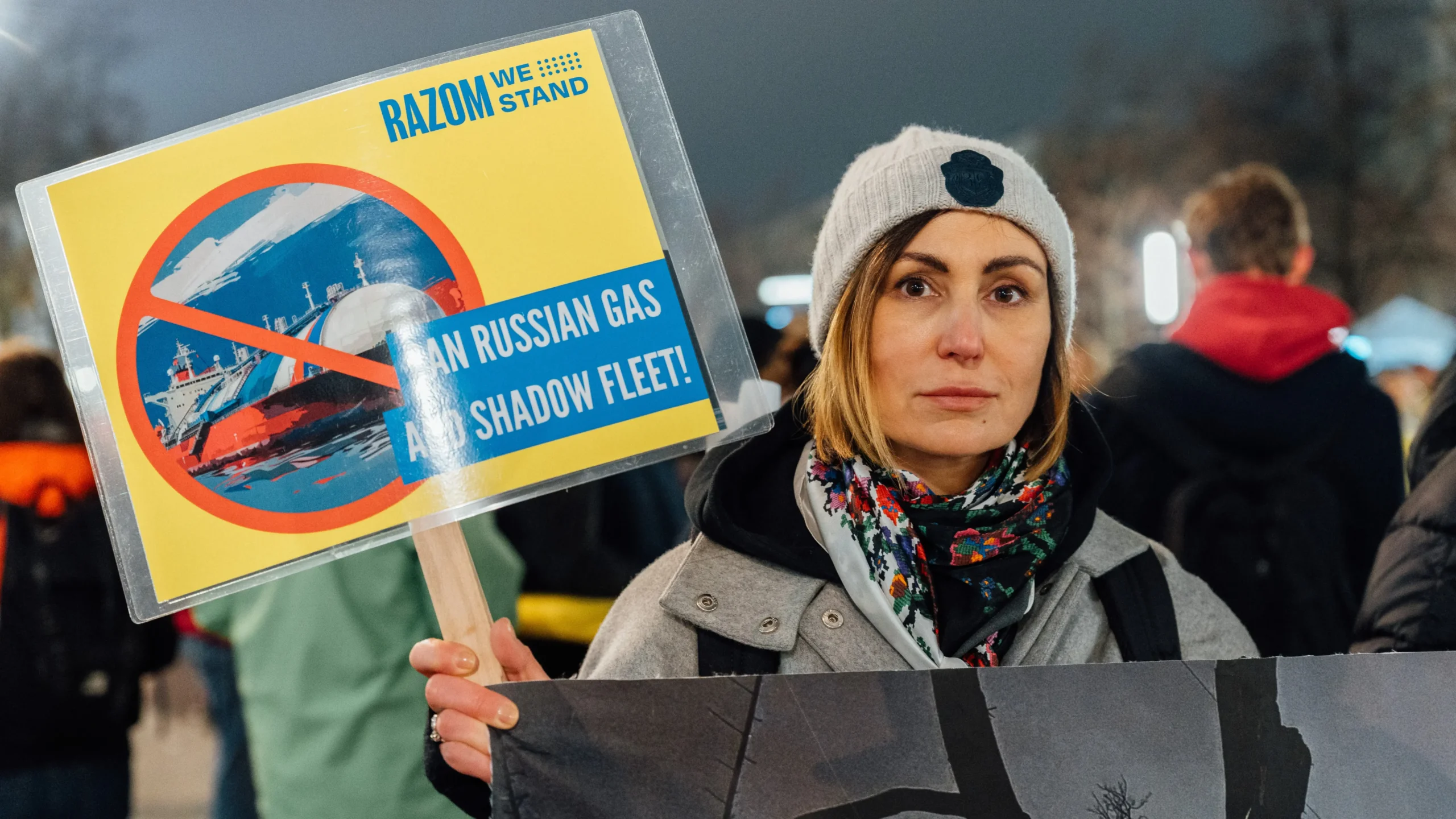
- Sanction all the LNG tankers tied to Russian LNG projects. Out of 81 LNG vessels identified by Razom We Stand, the EU has sanctioned only 18 of them (15 standard LNG tankers, 2 offshore ships and only 1 Arc7 ice class carrier). Arc7 carriers are particularly valuable to Novatek, Russia’s second-largest gas producer, which relies heavily on them.
- Prohibit EU shipyards such as Damen and Fayard A/S from repairing and maintaining Russian Arc7 ice-class LNG tankers.
- Sanction Novatek and its subsidiaries, as well as Novatek’s CEO Leonid Mikhelson, following the examples of the UK in 2022 and Ukraine in 2025.
- Prohibit any transactions with Russia’s Yamal LNG and Arctic LNG 2 terminals, building on the current prohibition of future investments in, and exports of equipment and technology to LNG projects under construction in Russia.
Decisive action is needed. Each day the EU delays sanctions on Russian LNG means more money for the Kremlin and more missiles killing and wounding innocent Ukrainians.
Sanctions on LNG would close one of the last major loopholes in the EU’s sanctions regime against Russia and prove that the EU —and not a wavering United States— can lead in defending peace, global security and climate action.
Together, Commission President von der Leyen and the leaders of all 27 EU Member States must act: Fully ban Russian LNG once and for all.
Signatories:
- Dr. Svitlana Romanko, Founder and Executive Director, Razom We Stand (Ukraine)
- Nezir Sinani, Executive Director B4Ukraine
- Chiara Martinelli, Director, Climate Action Network (CAN) Europe
- Natalia Gozak, Director, Greenpeace Ukraine
- Tobias Münchmeyer, European Campaign Director, Greenpeace
- Dominic Kavakeb, Co-Director of Campaigns, Global Witness
- Laura Thieblemont and Marie Cohuet, Presidents, NGO Amis de la Terre France
- Kate Blagojevic, European Regional Director, 350.org
- Catalina Girona, Secretary, Associació d’Amics de Catalunya i Ucraïna UCRACAT (Barcelona)
- Ninni Kähkönen, Steel Specialist, Just Shift (Finland)
- Sascha Müller-Kraenner, Executive Director, Deutsche Umwelthilfe (Germany)
- Iryna Shulikina, Chairwoman and Executive Director, Vitsche e.V (Germany)
- Yanina Basysta, Director, CSO “Ecosmart” (Ukraine)
- Yuliia Melnyk, Co-founder and Director, NGO Ekoltava (Ukraine)
- Ana Otilia Nutu, Co-founder, Expert Forum (EFOR), Romania
- Oleg Lystopad, Expert, ANTS, Ukraine
- Kateryna Raban, Head of NGO “Zero Waste Lutsk”
- Nataliia Haietska, Head of NGO “Mariupol Zero Waste”
- Anastasiia Martynenko, Head of NGO “Zero Waste Society”
- Iryna Shchetynina, Head of NGO Zero Waste ZP, Ukraine
- Liubov Akulenko, Executive Director, “Ukrainian Centre for European Policy”
- Danylo Vankocych, Head of NGO “Center of Economic and Law Analytics” (Ukraine)
- Sofiya Shutiak, Attorney at Law, UNBA (Ukraine)
- Olexi Pasyuk, Centre for Environmental Initiatives ‘Ecoaction’
- Steven Vanholme, Programme Manager, EKOenergy ecolabel
- Katarzyna Wiekiera, Workshop for All Beings, Poland
- Daniel Therkelsen, Director, Coal Action Network (UK)
- NGO Ecoclub, Executive Director, Andriy Martynyuk (Ukraine)
- Ruslan Shcherbakov, President, NGO Fund Regional Center for Economic Research and Business Support, RcErBs (Ukraine)
- Jaromír Němec, Statutory body, NESEHNUTI Brno (Czechia)
- Anastasiia Khymychuk, Chairwoman, StateWatch Think Tank (Ukraine)
- James Hiatt, Executive Director, For a Better Bayou (USA)
- Andy Gheorghiu Consulting, Germany
- Alex Cornell du Houx, President, Elected Officials to Protect the Earth (USA)
- Martin Vladimirov, Director, Energy and Climate Program, Center for the Study of Democracy
- Hanna Hopko, Chairwoman of the Board of ANTS, co-founder of the International Center for Ukrainian Victory, (Ukraine)
- Kuba Gogolewski, Project Coordinator and Programme Director, Mission Possible, Poland
- Ilona Solohub, VoxUkraine
- Tom Kessler, Co-facilitator, Third Act Texas
- Barbora Urbanová, Director, Centre for Transport and Energy (Czechia)
- Heffa Schücking, Director, urgewald e.V. (Germany)
- Iryna Chernysh, Head of SaveDnipro NGO (Ukraine)
- Daryna Pyrogova, Head of U-Cycle NGO (Ukraine)
- Lesya Loyko, Head of FORZA NGO (Ukraine)
- Mariia Fedoruk, Coordinator of Ukraine Nature Network (Germany)
- Mahi Sideridou, Managing Director, Beyond Fossil Fuels (BFF) Europe
- Liene Sebre, Member of Board, Green Liberty (Latvia)
- Dmytro Karabchuk, Executive Director, ForestCom
- Bohdan Prots, CEO, Danube-Carpathian Programme
- Anastasiya Volkova, Head of NGO ‘Permaculture in Ukraine’
- Radostina Slavkova, Environmental Association “Za Zemiata” – Friend of the Earth Bulgaria (Bulgaria)
- Iryna Zahorodnia, Head of the Project Department, RePower Ukraine Charitable Foundation
- Juliia Pushko, Head of NGO Green Growth Comms (Ukraine)
- Lorna Powell, Mothers Rise Up, UK
- Dr. Kjell Kühne, Director, Leave it in the Ground Initiative (LINGO) (Germany)
- Dr. Dakota Raynes, Senior Manager of Research, Policy, and Data, Earthworks (USA)
- Hans Lammerant, Vredesactie (Belgium)
- András Lukács, President, Clean Air Action Group
- Nino Evgenidze – Executive Director, Economic Policy Research Center (Georgia)