After Russia’s full-scale invasion of Ukraine, Germany moved with unprecedented speed to build its dangerous reliance on US LNG, describing it as “diversification from Russia” and “energy security.” In just 194 days, the first costly LNG terminal in Wilhelmshaven was built with billions of euros in public subsidies, as a floating regasification facility designed to replace Russian pipeline gas.
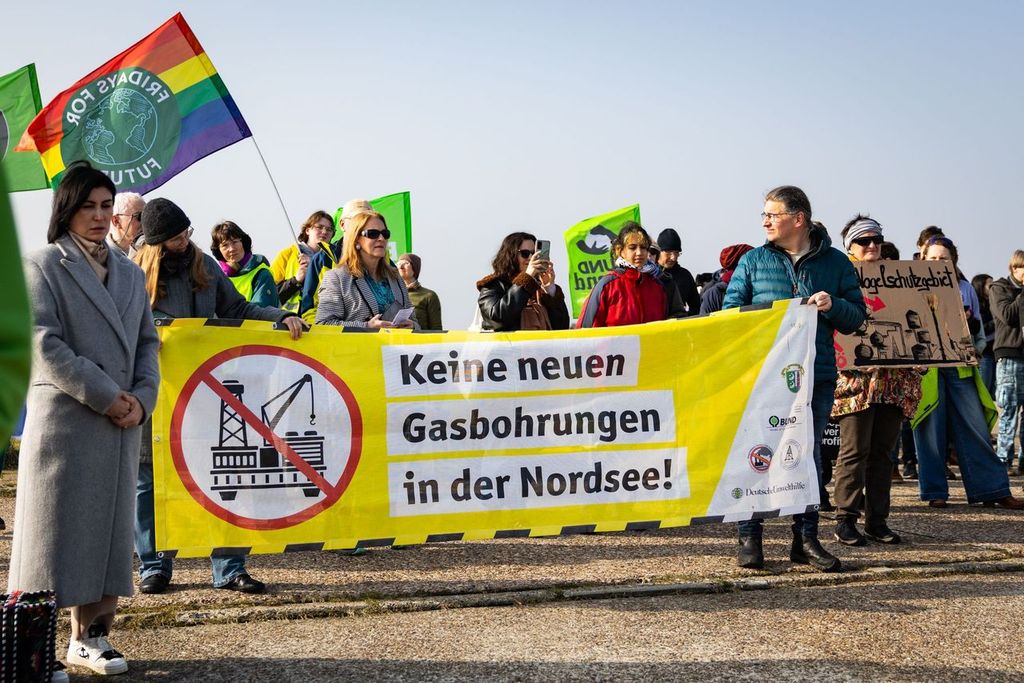
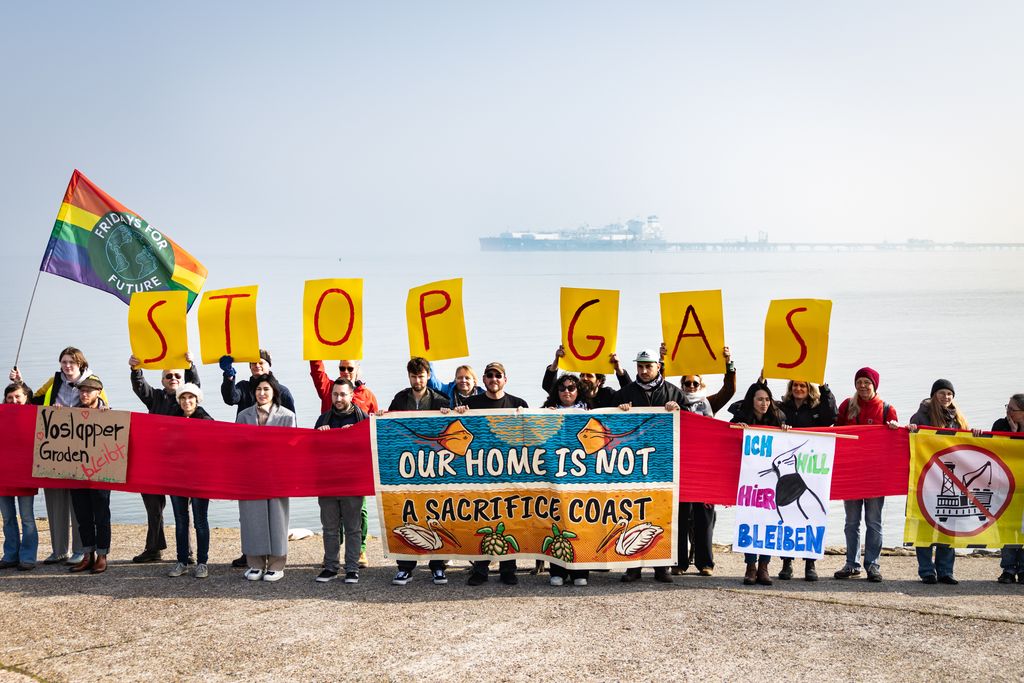
Last week, Razom We Stand, together with other international civil society organisations and activists, joined Fridays for Future Wilhelmshaven for a demonstration against LNG at the Wilhelmshaven terminal.
The terminal can import around 7.5 billion cubic meters (bcm) of gas per year, roughly 8% of Germany’s annual demand. A second terminal was launched in 2025, adding another 4.6 bcm of annual capacity. Now, plans are underway to quickly build a third one, threatening to eliminate entire ecosystems in the process. This was done at a public cost of billions, which should have instead been spent on cheaper renewable energy.
Today, the difficult question is whether Europe is building far more LNG capacity than it will actually need, as gas demand declines and the energy transition accelerates. Billions of euros risk being locked into infrastructure that could become stranded assets long before the end of its intended lifetime.
And LNG is not a neutral bridge fuel.
Across Texas, Louisiana, and the Gulf of Mexico Coast, the consequences of unchecked fossil fuel expansion are already visible: disappearing wetlands, rising methane pollution, damaged coastal ecosystems, and entire communities living next to massive export terminals. Some of these areas are already becoming environmental sacrifice zones and cancer alleys.
These are warnings Europe should take seriously.
Energy security cannot mean replacing one expensive fossil dependency with another. This is also true for us in Ukraine. Ukraine faces a serious risk that companies like Venture Global LNG will try to enter the country under the banner of reconstruction and invest in expanding gas extraction.
But rebuilding Ukraine must not mean locking our future into a new cycle of outdated fossil fuel dependence. If large fossil fuel companies rush to develop new dirty gas fields and export infrastructure, we risk delaying, or even derailing, the opportunity to rebuild our energy system on cheaper, clean, modern, and resilient foundations.
The real strategic answer is the faster deployment of affordable renewables, electrification, gas demand reduction and energy efficiency — not another generation of gas infrastructure that wastes public money and damages fragile coastal ecosystems.