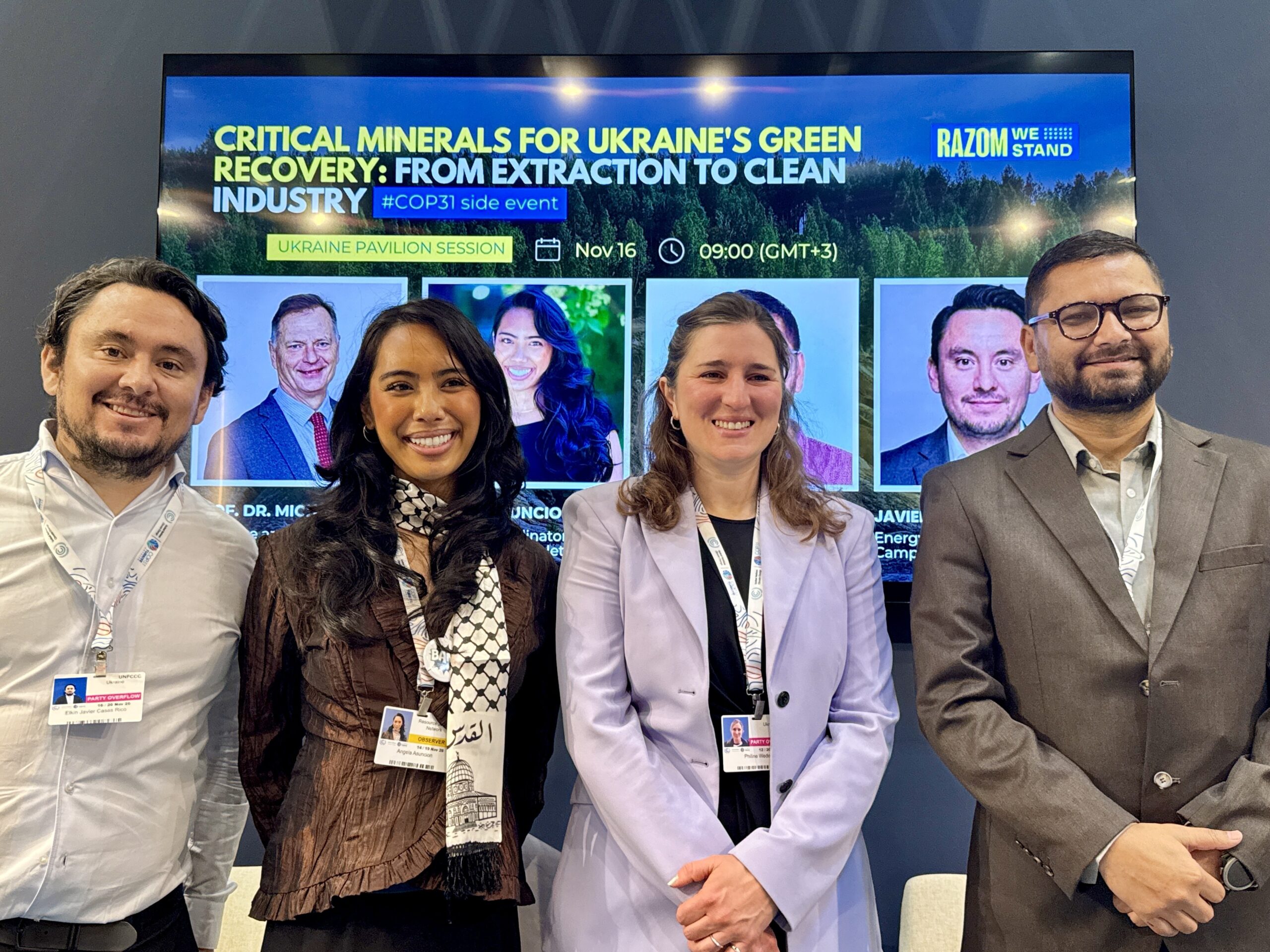
Monday 16 November, Razom We Stand hosted the “Critical Minerals for Ukraine’s Green Recovery: From Extraction to Clean Industry”, a side event at the Ukraine Pavilion at COP31 in Antalya.
Javier Casas, who leads our work on energy transition minerals, moderated a discussion with Angela Asuncion of Resource Justice Network, Sunil Acharya of Recourse, Philine Wedell, Managing Director of IKEM and Dr Alyona Shulima, a prominent Ukrainian lawyer and government relations specialist.
Geological potential is not a mature industry
Javier opened with findings from our research on Ukraine’s mining permit system where we identified more than 2,000 mining permits. Around 60% relate to construction materials and dimension stone, and only around 5% cover industrial minerals, metals and critical minerals. Ukraine has significant mineral potential, but it does not yet have a mature critical minerals industry waiting to be scaled up.
Many important decisions are still ahead. Nearly 500 mining permits are due to expire in 2026 and 2027 and within the metals and critical minerals category specifically, around 30% are due to expire over the same period. This is a chance to look closely at licensing, ownership, environmental obligations and standards.
Ukraine has made progress, including digitalised licensing and a long-term critical minerals strategy aligned with European standards, but the challenge now is implementation. Our paper on critical minerals governance risks and conflict prevention in Ukraine looks at what that means in practice.
Two messages for COP31
First, transparency is necessary, but it does not guarantee accountability. Data on licences, ownership and the environment only matters when institutions can act on it, rules are enforced, communities can take part and breaches have consequences. That is why we are building monitoring tools, including a map of companies and licences in Ukraine’s extractive sector and a tracker of projects linked to the US–Ukraine Minerals Deal.
Second, a critical mineral is not automatically a ‘green’ mineral. Graphite, lithium, manganese and titanium may be essential for clean technology, but their contribution to the transition depends on how they are extracted, how projects are financed, how impacts are managed and who benefits.
What did the panel say?
Communities need real decision-making power. Angela Asuncion highlighted that meaningful participation means free, prior and informed consent, including the right to say no, from before a project is conceived. She said multi-stakeholder groups within EITI should include direct seats for affected communities and Indigenous peoples.
Asuncion said: “We know that the just transition cannot be built on new forms of colonial exploitation. We must chart a path towards a just transformation which ensures that all rightsholders, Indigenous Peoples and communities affected across the transition mineral supply chain are protected, empowered and benefit from shared prosperity.”
Public finance must deliver public value. Sunil Acharya warned against assuming that extraction is automatically a climate solution, noting that wealth from minerals has too often been created elsewhere while mining communities bear the harm. For multilateral development banks and other public finance, he set out three requirements: economic sovereignty and domestic value creation, respect for rights and ecological limits, and public value rather than socialised risk and privatised profit. Not every deposit needs to be developed.
In the second round he proposed measuring success by how much economic value stays in the country, whether decent jobs and local skills are created, whether communities can access information and influence decisions (not just attend consultations), and who carries the financial risk and controls the technology.
A contradiction at the heart of the transition. Philine Wedell described the tension in building a cleaner energy system on mineral supply chains that can still cause environmental damage and social inequality. One country’s strategic autonomy should not come at the expense of producing countries such as Ukraine, she said, and partnerships should support local processing and technology transfer. She also stressed circularity and better alignment of international rules and due diligence.
The Ukrainian government’s view. Alina Shulima said Ukraine is improving access to geological information, running electronic auctions and discussing production sharing agreements. Environmental impact assessment continues for mining during the war, and legislation on extractive waste is being developed in line with EU law. She stressed that communities should see tangible benefits such as jobs, infrastructure and tax revenue.
Electrification: for whom, and who pays?
An audience question on electrification drew three answers.
Philine Wedell said it should be powered by renewables. Sunil Acharya said the question missing from the COP31 debate is what kind of electrification is meant, who finances it, and whether it will reach people who still lack power or mainly serve data centres, AI and private vehicles. Angela Asuncion added that no electrification target will be met without the mining communities that host the materials the transition needs.
What comes next
Ukraine has an opportunity to avoid a model in which resources are extracted and exported while much of the economic value is created elsewhere. The objective should not simply be more mines. It should be to use mineral development to support reconstruction, processing, skills and clean industrial development inside Ukraine, with communities given a meaningful voice and safeguards built in from the start. Razom We Stand will keep developing the monitoring tools described above to help make that possible.