Oleh Savytskyi, Razom We Stand
While preparing for the new heating season Ukraine is seeking to raise hundreds of millions of euros for additional gas imports. At the same time, the country continues to lose significant volumes of its own gas reserves due to leaks, venting and flaring. In the context of the war, this is no longer merely an environmental issue, but a matter of energy security and the effective use of international aid. Before increasing imports, the state must know exactly how much gas is being lost within the country — and systematically reduce these losses.
Lost gas – an alternative to purchased gas
In early August, the government announced that Naftogaz was short of around 400 million euros to purchase additional gas ahead of the heating season. In the context of the war and systematic Russian attacks on gas production infrastructure, imports may indeed be necessary to build up the required reserves for the winter. But before seeking hundreds of millions from international partners once again, the state must ask an equally obvious question: how much of its own gas is Ukraine still losing through leaks, venting into the atmosphere and flaring – and what has been done to minimise these losses?
Methane is not only the main chemical component of natural gas, but also a potent greenhouse gas; consequently, its release into the atmosphere is receiving increasing attention from international organisations and is even being monitored using specialised satellites. All major methane leaks into the atmosphere are now detected from orbit in near real time.
International analytical sources point to significant gas wastage in Ukraine. Gas is not only released into the atmosphere due to outdated equipment and damaged infrastructure, but is also burned inefficiently.
According to data from the annual report of the World Bank’s Global Flaring and Methane Reduction Partnership, Ukraine was among the countries where gas flaring volumes increased significantly in 2025; specifically, compared with 2024, the increase amounted to 230 million cubic metres – that is, almost a quarter of a billion cubic metres of gas.
Of course, in the context of the war, some of this flaring may have been due to damage, emergency operations or disruptions to infrastructure. But that is precisely why the figure of 230 million cubic metres should serve not as an excuse, but as a reason to carry out a detailed inventory and explain where, by whom and why this gas was flared.
The World Bank estimates that in 2025, a record 167 billion cubic metres of gas, worth around $54 billion, was needlessly flared worldwide. This volume of gas is 1.5 times greater than the amount exported by Qatar and other Gulf states prior to the blockade of the Strait of Hormuz caused by the US-Iranian war. At the same time, technologies to drastically reduce routine flaring have long been available.
The main barriers are old infrastructure, insufficient funding, inadequate regulation and, ultimately, the fact that operators and governments do not prioritise the issue sufficiently.
An even more alarming picture is painted by the International Energy Agency’s Global Methane Tracker 2026 report. In the graph showing methane emissions from the energy sector in Europe for 2025, Ukraine ranks first among the individually listed European countries in terms of absolute methane emissions – ahead of Poland, the UK and Romania. According to the International Energy Agency, methane emissions into the atmosphere from the oil and gas sector in Ukraine in 2025 amounted to around 500 million tonnes, equivalent to 720 million cubic metres of natural gas.
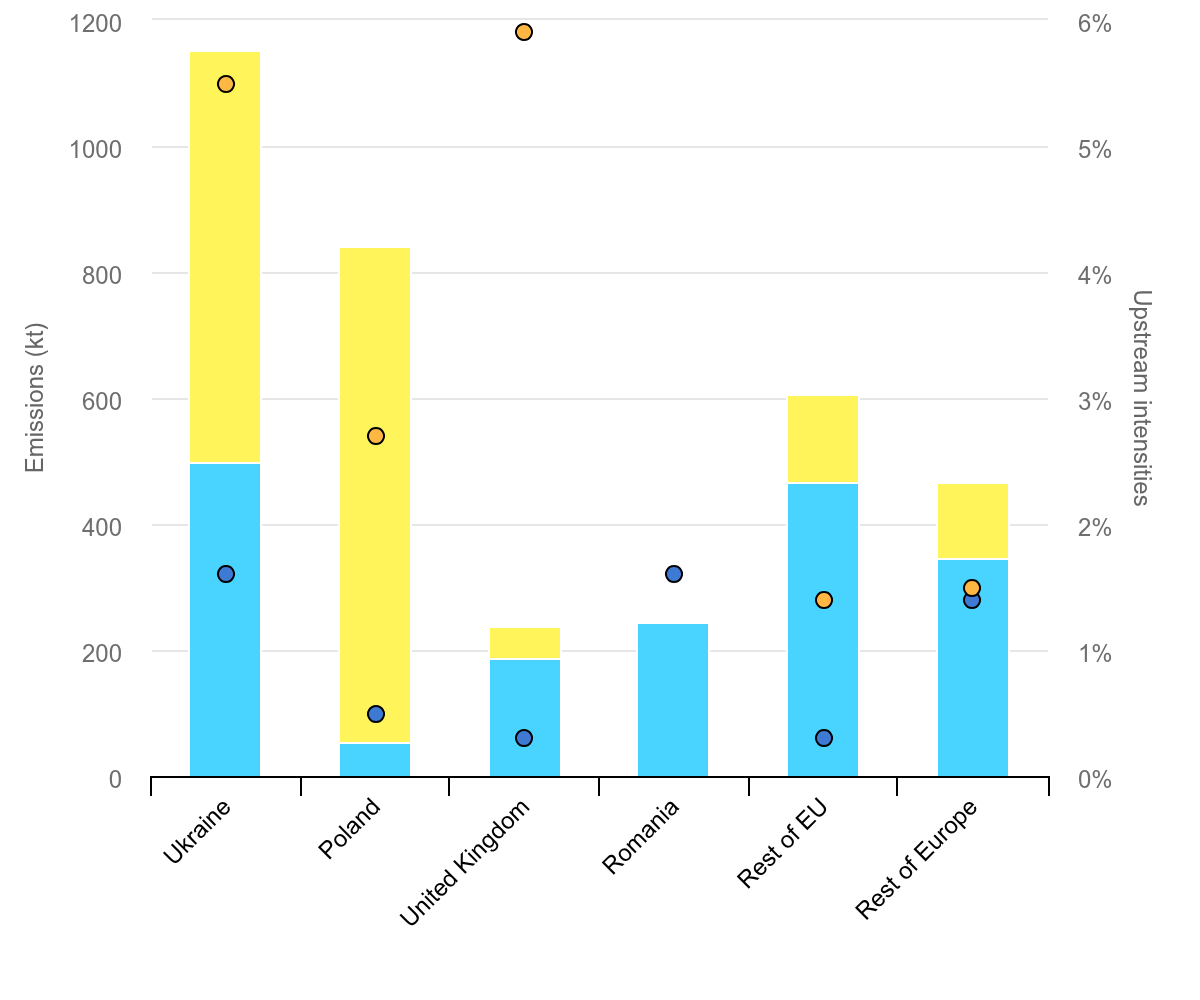
For Ukraine, reducing atmospheric venting and gas flaring is a matter of energy security. Every cubic metre that is saved – not lost, not released into the atmosphere and not burned uselessly – potentially reduces the need to purchase gas abroad using foreign currency. This is particularly true now, whilst infrastructure remains a target for Russian attacks.
Reducing emissions as a priority
This is precisely why the government and the supervisory boards of state-owned energy companies must prioritise reducing methane losses and emissions on a par with increasing production and purchasing gas. The first necessary step towards this is a comprehensive inventory of methane emission sources across the entire state oil and gas sector. Gas TSO of Ukraine, Ukrgazvydobuvannya, Ukrtransgaz, Gas Distribution Networks of Ukraine and other state-owned operators must officially join the Oil and Gas Methane Partnership 2.0 (OGMP 2.0) – UNEP’s flagship programme and the leading international standard for managing methane emissions data.
It is essential to ensure full coverage of physical assets in the oil and gas sector through reporting at least at OGMP 2.0 Level 3, i.e. establishing detailed records of emissions by specific source types. But we must not stop there. A clear roadmap is needed for the transition to Levels 4 and 5 – through the implementation of systematic instrumental measurements at the level of individual sources and entire facilities, followed by the reconciliation of these data. The very logic of OGMP is based on a gradual transition from calculated estimates to measured data.
At the same time, regular leak detection and repair (LDAR) programmes must be implemented at compressor stations, production fields, gas gathering networks, gas processing plants, storage facilities and pipeline infrastructure. In practice, this means a shift from accounting for losses using standardised coefficients to a continuous cycle of monitoring, rapid response and the maintenance of digital databases: locate a leak – measure it – repair it – verify the repair – record the data – report transparently.
At the same time, it is worth noting a positive development – the systematisation of information on existing wells carried out by the State Agency for Geology and Subsoil of Ukraine and the launch in 2025 of the State Register of Oil and Gas Wells. To date, it already records over 13,700 wells, including operational, decommissioned and other categories. This is an important foundation for bringing order to the management of the state’s oil and gas assets. This register should mark the beginning, not the end, of the work. The next step is a systematic survey of mothballed and inactive wells, an assessment of their technical condition, the prospects for resuming production, and mandatory monitoring for potential methane leaks.
There should be no ‘unmanaged wells’ left in Ukraine. Where it is technically and economically feasible to resume production, this resource must contribute to the country’s energy security. Wells where further use is not viable must be securely sealed and decommissioned, with a designated responsible operator and monitoring to ensure there are no leaks. This approach will simultaneously reduce methane emissions, environmental risks and the wasteful loss of the country’s own energy resources.
Ukraine cannot afford to simultaneously ask its international partners for hundreds of millions of euros to import gas whilst failing to know, with the greatest possible accuracy, how much gas is being lost. Preparations for winter must not begin solely with import contracts. They must begin with putting the country’s own oil and gas infrastructure in order – by measuring every significant loss and taking specific measures to eliminate them.
***
This material has been produced with the financial assistance of the Ukraine2EU Programme. The views and opinions expressed are the sole responsibility of Razom We Stand and do not necessarily reflect the position of the Ukraine2EU Programme or those of the European Union.