By Dr Svitlana Romanko
This article originally appeared in Surplus
In the fourth year of war, signs of a weakening Russian economy are emerging—yet Germany and the EU must intensify pressure. Despite sanctions on Russian fossil fuels, Europe still imports liquefied natural gas (LNG) from Russia for heating and power, exposing its citizens to the risk of rising heating bills. Thus, Europe funds the war it condemns instead of pivoting to cheaper clean energy, while giving Moscow a key to control of European energy security. Meanwhile, since 2022, Moscow has pocketed around one trillion euros from fossil exports.
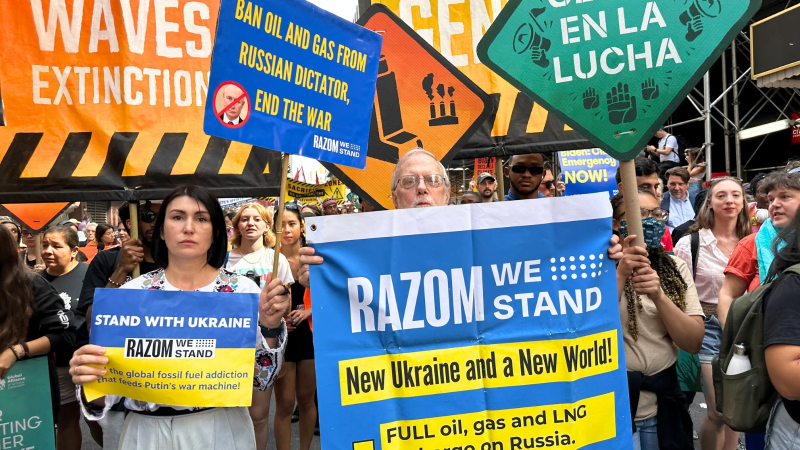
For years, the campaign group I founded in 2022, Razom We Stand, has exposed this link as well as the hypocrisy of European statements in support of Ukraine. We have shown that Russia is able to circumvent sanctions – and Europe keeps playing along.
First efforts to control trade in Russian oil included an oil price cap intended to limit Russian income from oil exports. But with Iran’s advice on sanctions evasion, Russia quickly found ways to get around the price cap by selling to China and other countries that ignored the measures, as well as through nefarious ship‑to‑ship transfers in international waters, reflagging ships into permissive jurisdictions, and obtaining dubious or falsified insurance certificates. The result is a sanctions regime full of loopholes that Moscow has learned to exploit.
How the oil keeps flowing
The EU embargo and the price cap should have choked the Kremlin’s export revenues. But in practice, they have merely rerouted flows rather than drying them up. Russia still produces over 9 million barrels of oil per day and exports several million barrels daily, only now most of those barrels move on different routes and under different flags.
A key instrument of this adjustment is the shadow fleet: up to a thousand ageing, leaky tankers with opaque ownership, often registered under flags of convenience and operating with minimal transparency. Estimates now suggest that a majority of Russia’s seaborne crude is carried by such vessels. They loiter off EU coasts or in international waters, perform ship‑to‑ship transfers and arrive in ports with paperwork that obscures the original loading point.
At the same time, the Kremlin has deepened ties with a small group of buyers. China and India have consistently remained major customers, buying crude at a discount, refining it, and exporting diesel, petrol, and other products. These fuels flow back to sanctioning countries, including in the EU. The absurd outcome: While Europe has banned most direct imports of Russian oil, loopholes in gas and LNG, remaining pipeline exemptions and weak enforcement still allow billions in Russian fossil revenues to flow.
How much oil, how much money?
Recent analysis by independent researchers at CREA show that Russia still earns hundreds of millions of euros per day from fossil fuel exports, even after discounts and reduced volumes. Oil remains the largest contributor, followed by gas and LNG. Monthly oil export revenues have fallen compared to pre‑war highs, but they remain in the tens of billions of dollars per year – enough to fund a drawn‑out war economy, pay soldiers and import weapons components through intermediaries.
LNG has proven even more resilient than expected. While pipeline gas flows to Europe have dropped steeply, Russia’s LNG exports have grown, and the EU has become one of the key destinations, spending about 7.2 billion euros on Russian liquefied natural gas in 2025. Cargoes from Russia’s Yamal LNG project and others arrive at European terminals, are regasified and enter the market as if they were just another commodity. Russia’s LNG revenues have therefore become an increasingly important pillar of its energy income – and a blind spot of European sanctions policy.
Taken together, these flows underpin a war budget that would look very different if oil and gas income were cut off decisively. Sanctions have cut Russia’s federal budget revenues from oil and gas in half, increased Russia’s costs and narrowed its options, but they must be further tightened to create the real economic pressure on Russia that would allow Ukraine to negotiate from a position of strength in ongoing US-led peace talks.
Who profits from the loopholes?
Behind every loophole stands a balance sheet. European actors are deeply involved in keeping parts of this trade alive. Shipping companies like Seapeak in the UK and those based in EU member states, like Dynagas in Greece, have helped move large volumes of Russian fossil fuels, even as their governments negotiate new sanctions packages. Flags of convenience continue to register high‑risk vessels. Some insurers and financial intermediaries still participate where legal grey zones and weak enforcement permit them to do so.
Major energy corporations also straddle the line. Several have exited certain Russian projects but remain invested in others, especially LNG and Arctic ventures, while simultaneously supplying European governments and public institutions. In Europe, public buildings have been heated with gas supplied by Russia-friendly companies, such as France’s TotalEnergies, which holds stakes in Russian energy projects including Yamal LNG. This business-as-usual cooperation with Russia must end.
What must change
Major shifts are needed if Europe wants sanctions to do what they were promised to do: curtail Russia’s ability to wage war.
First, the EU and G7 should move from price caps to a clear maritime services ban on Russian oil and LNG: no shipping, insurance, certification, financing or port services from European and allied jurisdictions for vessels carrying these cargoes, regardless of destination. This directly targets trade logistics rather than micromanaging prices at a distance.
Second, regulators must take the shadow fleet seriously. That means denying port access to high‑risk tankers, enforcing transparency on ownership structures, publishing and using blacklists of vessels engaged in deceptive practices, and seizing ships that repeatedly breach sanctions.
Germany recently took action by forbidding the shadow-fleet oil tanker Tavian from entering their territorial waters, but such action needs to be consistent and regular to be taken seriously by Russia. Without a chance to sail freely to safe ports, to receive reliable insurance or access to repair and classification services, the shadow fleet’s profitability would disappear.
Germany’s choice: manage dependence – or end it
Germany is central to this story. Its energy choices starting in the 1960s helped entrench Europe’s dependence on Russian gas and oil; its current choices will help determine whether that dependence finally ends. Germans who used gas for heating could see the geopolitical shifts in their heating bills: for a long time, gas had been the cheapest heating fuel. Since Russia attacked Ukraine, German households pay almost 80 per cent more after volatile energy import prices skyrocketed.
Germany has already begun replacing Russian pipeline gas, including with cheaper renewable energy, which gives real energy security, but that’s not enough. As long as Russian LNG and products refined from Russian oil can still enter the German and European market, the economic umbilical cord to the Kremlin is not cut.
Germany must now actively lead Europe in ending this dependence that it helped create. Leading means committing to a complete phase‑out of all Russian fossil fuels, including LNG and indirect imports via third countries. It also means pushing in Brussels for the strongest possible maritime services ban, robust enforcement against the shadow fleet, and rules that make it impossible to “launder” Russian oil through refining hubs.Every euro Russia earns from fossil exports today will be paid back with interest: in destroyed Ukrainian cities, in higher future security costs for Europe, in a more chaotic energy transition. Germany can help change that equation. By aligning its energy policy and EU diplomacy with a single principle – no more blood money in tankers – it can turn sanctions from a story of loopholes into a tool that actually works to dry up Russia’s war chest, and bring a just peace to Ukraine.