By Oleh Savytskyi
The UN Secretary-General’s new Call to Action on Methane comes at exactly the right moment. Methane reduction is no longer a niche climate issue. It is one of the fastest, cheapest and most effective ways to slow global warming in the near term, while also improving air quality and cutting avoidable energy waste.
This message is especially relevant for Europe. The EU Methane Regulation is now facing growing political pressure from fossil fuel exporters and industry groups that want to delay or weaken its implementation. Recent reporting has shown that major gas suppliers, including the United States and Qatar, have urged the EU to change the rules, warning of supply risks. At the same time, EU Energy Commissioner Dan Jørgensen has said the Commission is ready to be pragmatic on implementation, but will not reopen or dilute the legislation.
The International Energy Agency has made the case even stronger. Its Global Methane Tracker 2026 estimates that around 70% of methane emissions from fossil fuels — nearly 85 million tonnes — can be abated with existing technology. More than 35 million tonnes could be avoided at no net cost, because the value of captured gas can exceed the cost of mitigation. The IEA also stresses that tried-and-tested policies — leak detection and repair, limits on venting and flaring, technology standards and performance requirements — could cut global oil and gas methane emissions by more than half.
In other words, the world does not lack solutions. It lacks implementation.
This is why the EU Methane Regulation matters. It turns methane action from voluntary corporate messaging into a real regulatory framework. Within the EU, it requires better monitoring, reporting, verification, leak detection and repair, and action on venting and flaring. It also obliges member states to address methane from abandoned coal mines and inactive oil and gas wells. For imports, the regulation phases in requirements on origin, routes, MRV systems and methane intensity, including a 2027 requirement for importers to demonstrate that fossil fuels were produced under equivalent MRV rules or, for oil and gas, under OGMP 2.0 Level 5 verification.
This is exactly the kind of policy architecture the UN Call to Action points toward: moving beyond voluntary pledges and building systems that deliver measurable reductions.
The latest debate in Germany shows why political consistency is essential. German Economy and Energy Minister Katherina Reiche had reportedly called for a reworking or postponement of the EU methane rules, warning that they could affect gas and petroleum-product imports. But on 8 July, German Environment Minister Carsten Schneider clarified in the Bundestag that Germany is not in favour of postponing the regulation. He stated that Reiche’s comments were not aligned with the agreed government position and that the government’s internal rules of procedure had not been followed.
That clarification matters far beyond Berlin. Europe’s credibility depends on showing that climate rules are not optional when fossil fuel interests object. The EU and Canada, as co-conveners of the Global Methane Pledge, have welcomed the UN Secretary-General’s Call to Action and reaffirmed that strong methane regulation can support both climate goals and energy security. Their joint statement put it clearly: every cubic metre of methane emitted heats the planet instead of a home.
For Ukraine, this debate is not abstract. Effective methane regulation is directly linked to Europe’s phase-out of Russian fossil fuels. Origin tracing, transparent supply-chain data and methane-performance standards can help prevent Russian gas from re-entering the European market through intermediaries, relabelling or opaque trade routes. Weak implementation would create loopholes exactly where Europe needs clarity.
Ukraine also has its own strategic reason to support strong EU methane rules. As a candidate country aligning with the EU energy and climate acquis, Ukraine needs to build modern MRV systems, strengthen leak detection and repair, improve inventories for oil, gas and coal methane emissions, and prepare institutions for full implementation of Regulation (EU) 2024/1787. This is not only a compliance task. It is an opportunity to reduce wasted gas, improve transparency, attract cleaner investment and integrate Ukraine into a rules-based European energy market.
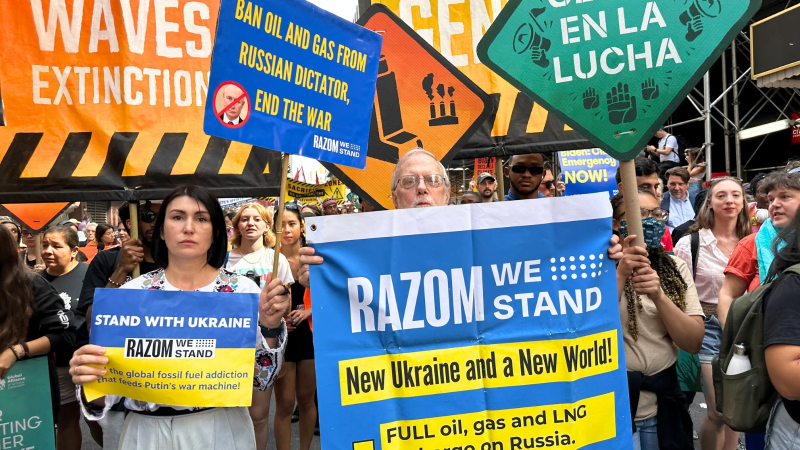
Razom We Stand supports the full and practical implementation of the EU Methane Regulation in Ukraine because methane mitigation brings together climate responsibility, energy security and accountability for fossil fuel supply chains. The current pressure to delay the regulation should be seen for what it is: a test of whether governments will act on the evidence presented by the UN, IEA and scientific community, or allow fossil fuel interests to postpone one of the most effective climate measures available today.
Europe should hold the line. Methane rules are not red tape. They are a practical instrument for cleaner energy, stronger security, and a faster end to dependence on Russian fossil fuels.
This material has been produced with the financial assistance of the Ukraine2EU Programme. The views and opinions expressed are the sole responsibility of Razom We Stand and do not necessarily reflect the position of the Ukraine2EU Programme or those of the European Union.